

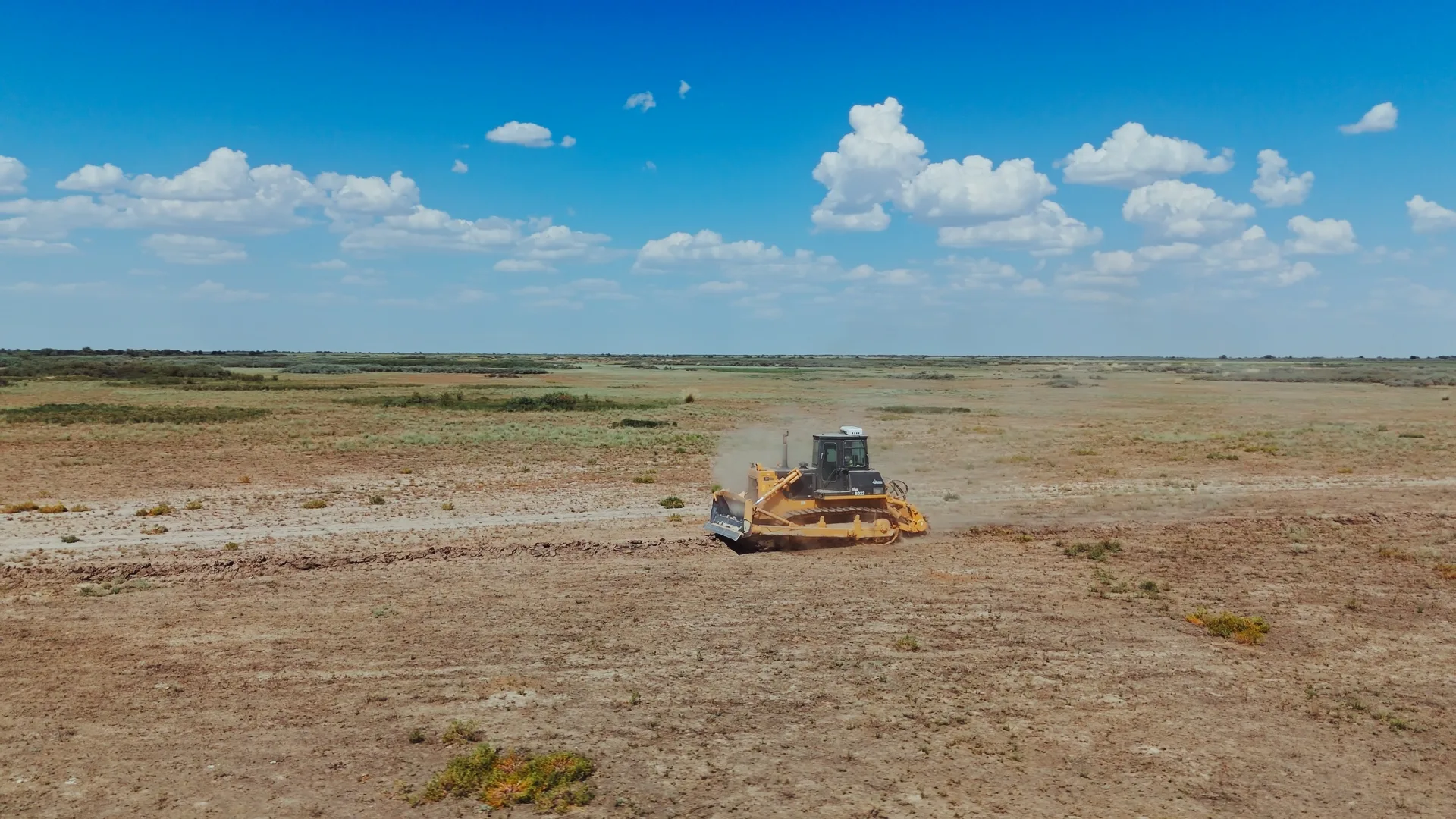
“Connecting a village to the internet” sounds like a question of tariffs and equipment. In practice it is a question of which network has to be built: a feeder line that brings fiber to the settlement, and a distribution network that takes it to the houses. Below are three of our projects, and what they show.
Similar kilometrage, different work
Divide route length by coverage, and our three projects barely differ: each household in the coverage area accounts for 21–22 m of route. So the kilometres-per-household ratio does not tell these projects apart. What does is the work those kilometres are made of.
Zhetigen and Urker make the point. The length is almost the same: 106.6 km and about 100 km. In Zhetigen, 106.6 km is the settlement’s feeder network, with an underground crossing under the railway; on top of it the project included the distribution network, communication nodes, and linear-cable structures. In Urker, about 100 km is the entire GPON network of a residential area in Astana, from the feeder part down to distribution across private houses and apartment buildings.
Three projects: length, coverage, scope of work
| Project | Length | Coverage | Route per household | What the kilometrage covers |
|---|---|---|---|---|
| Almaty Region | 4,253 km FOCL | ~200,000 households, 11 districts | ≈21 m | Regional network: communications and the Sergek system, PPP |
| Zhetigen (now the city of Alatau) | 106.6 km | 5,130 households | ≈21 m | The settlement's feeder network |
| Urker (Astana) | ~100 km | up to 4,485 subscribers | ≈22 m | The area's whole GPON network: feeder and distribution |
The Almaty Region project stands apart not only by scale. Besides communications, the same infrastructure carried the region’s intelligent security system: 2,508 video-surveillance poles and 325 APK of the Sergek system. One route carries two jobs — and that is typical for a regional project, where nobody will build a separate line for each task.
The complexity of the regional network shows in the course of the work too. The route grew 47% over the original plan — from 2,889 to 4,253 km; 208 new sites were integrated, and 192 sites were relocated at the client’s initiative during construction. Soils ranged from category 1 to category 5, with an increased share of horizontal directional drilling. The deadlines were still met.
Feeder line and distribution network: two different jobs
A feeder line between settlements and a distribution network inside a settlement differ in everything that sets the timeline: volumes, equipment, logistics, and pace.
| Parameter | Feeder line | Distribution network |
|---|---|---|
| Volumes | A long continuous route in the ground, few connection points | Many short sections: streets, houses, communication nodes |
| Equipment | Mechanized cable-laying columns, laying to a depth of 120 cm, HDD at crossings | Installation in cable ducts and on poles, drilling for poles, GPON equipment |
| Logistics | The column moves along the route; equipment and crews relocate between sections | Work inside a settlement: streets, yards, existing utilities |
| Timeline | Pace is set by soil category and the number of crossings | Pace is set by the number of houses and connection points |
Practical consequence: when assessing a project, route length must be split into two parts — how much feeder line and how much distribution network. The same kilometres in these parts mean different work.
The regional project: PPP and documentation
The Almaty Region project was executed under a public-private partnership contract from October 2024 to September 2025: the network was built under a long-term agreement, not under a payback period from subscriptions.
For the contractor this changes documentation requirements more than it changes the build. As-built documentation, staged acceptance, and confirmed volumes weigh no less than laying pace in such contracts.
What to ask when assessing a rural project
Four questions that give more than total route length:
- How many kilometres of feeder line and how many of distribution network? These are two different projects inside one.
- How many houses and connection points in the distribution part? They set the amount of installation inside the settlement.
- How many HDD crossings? Every river and railway is a separate operation in the schedule.
- What is the soil category by section? It determines which column goes out on the route and what pace is realistic.
We answer these questions before we name a timeline. If you have a route or a district — that is where we start.